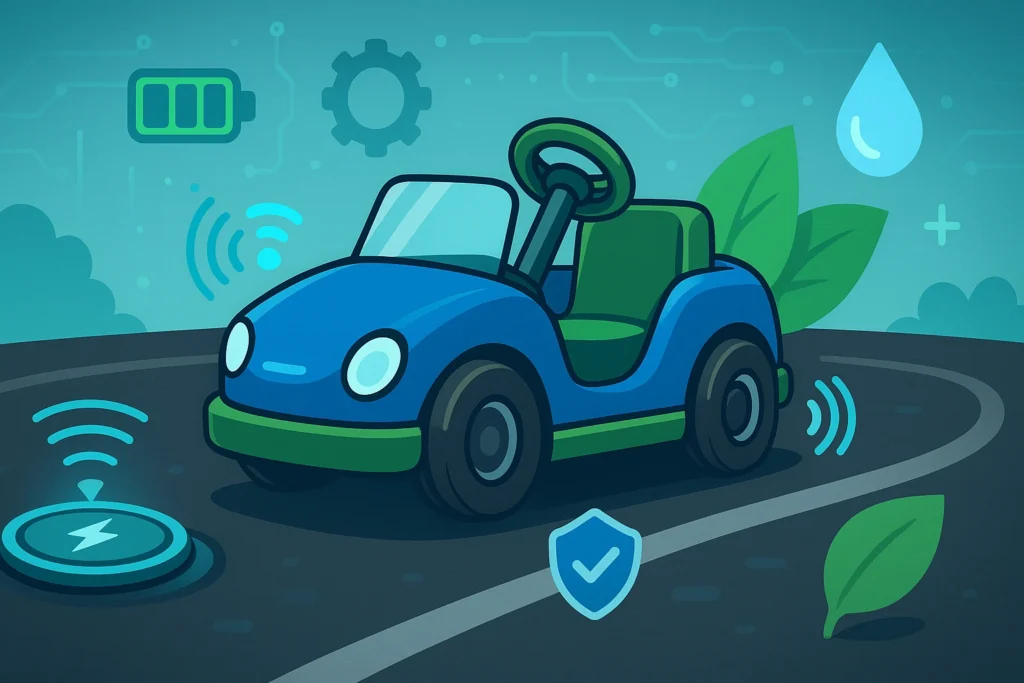
What core hardware modules are essential? ⚙️🔧
To build the best interactive induction driving school car, focus on a modular stack that can be scaled, serviced, and customized (OEM/ODM) without downtime.
- Drive & Chassis: Brushless hub motors, fail-safe brake, torque-limited acceleration, differential or dual-motor steering assist.
- Battery Pack & BMS: LiFePO₄ or NMC cells, smart BMS with cell balancing, thermal probes, short-circuit and over-current protection.
- Sensing Layer:
- Inductive/IMU: steering angle, yaw, acceleration for skid/over-steer detection.
- Ultrasonic / ToF: low-speed obstacle awareness.
- Magnet/QR track tags: route validation and checkpoint scoring.
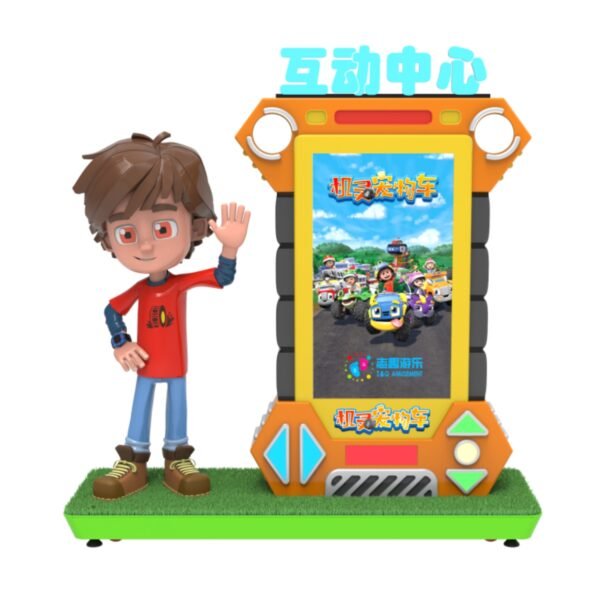
- HMI (Human–Machine Interface): 7–10.1″ TFT or LCD cluster, RGB status lights, haptic wheel feedback, emergency stop.
- Connectivity: BLE/Wi-Fi for telematics; optional UWB anchors for indoor positioning.
- Controller Stack: Automotive-grade MCU for real-time control + edge AI module for sensor fusion and behavior scoring.
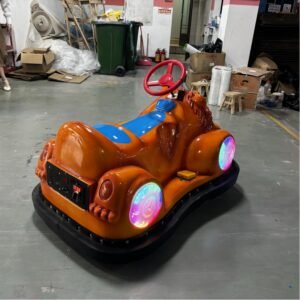
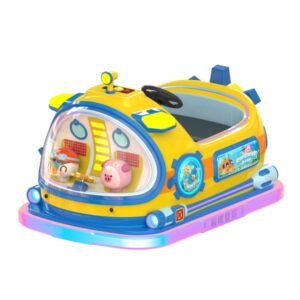
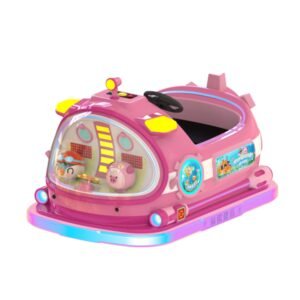
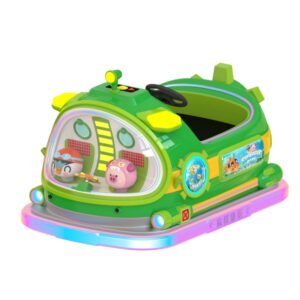
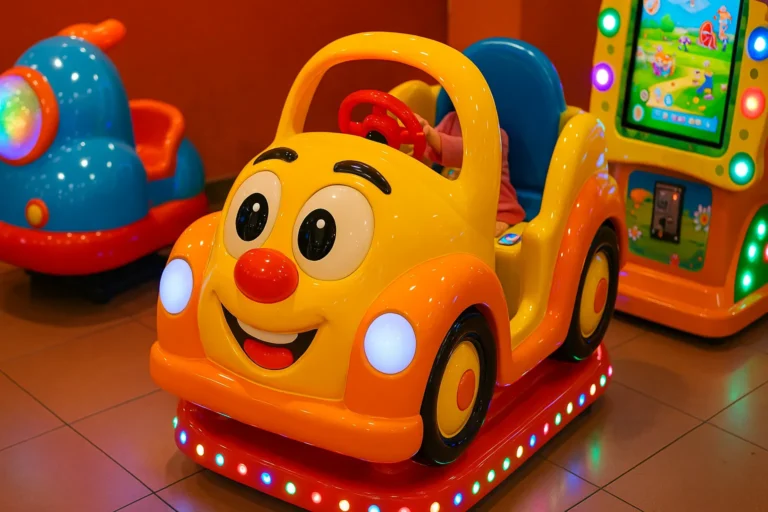
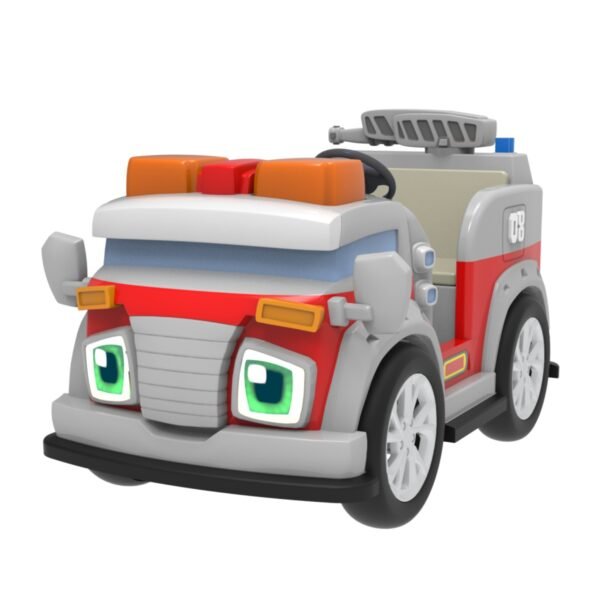
- Enclosure & Frame: Made of fiberglass structure with interactive sensing devices. Panels are impact-resistant, sun-resistant, waterproof (IP-rated seams), and drop-proof where applicable, with rounded edges for kids’ safety.
How should the software architecture be layered? 🧩📊
A three-layer architecture keeps the vehicle responsive and simple to maintain:
- Real-Time Control Layer (RTOS on MCU):
Motor control loops, brake logic, watchdogs, sensor sampling at deterministic rates, and safety interlocks. - Edge Intelligence Layer (Linux/RT Linux SBC):
Sensor fusion (IMU + wheel encoders + ultrasonic), route-matching, driving “rubrics,” and coaching logic. This layer computes a game-like score and delivers instant feedback: ✅ correct mirror check, ⚠️ harsh steer, ⛔ unsafe stop distance. - Cloud & Admin Layer (Optional):
Fleet dashboards, session replays, firmware OTA, consumables tracking, and order/maintenance tickets. Export anonymized KPIs for “school report” PDFs.
How does the Charging Mechanism of Induction Driving School Car work? 🔌🔋
Two patterns dominate:
- Contact Charging (Dock Pins):
Robust spring-loaded contacts in the dock engage bus bars beneath the car. The car authenticates the dock, negotiates current, and the BMS controls charge acceptance.- Pros: High efficiency, low RF complexity, lower price.
- Cons: Requires cleanliness and occasional pin maintenance.
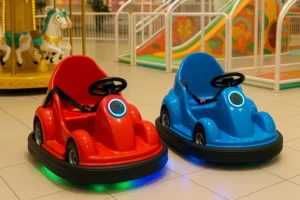
- Inductive Charging (Wireless Pad):
Coil in the dock couples with a vehicle coil; resonant compensation boosts efficiency. Foreign object detection + thermal roll-back protect plastics and fiberglass.- Pros: No exposed metal, superb for wet/“waterproof” operations.
- Cons: Slightly higher cost; careful pad alignment recommended.
What is the Production Component Impact on Battery-Powered Driving School Car? 🏭📈
Component selection directly affects reliability, uptime, and TCO:
- Motors & Gear Sets: Higher-grade magnets and sealed bearings reduce heat and extend long battery life.
- BMS & Cells: Automotive-rated MOSFETs and precise shunt sensing yield stable range predictions—critical for lesson planning.
- Sensors: IP-rated ultrasonic and IMU with low drift prevent false positives in the coaching system.
- Connectors & PCBs: Gold-flash contacts and conformal coating add sun-resistant/waterproof resilience in outdoor schools.
- Body Materials: UV-stable gelcoat on fiberglass panels retains color under sunlight and lowers cosmetic maintenance.
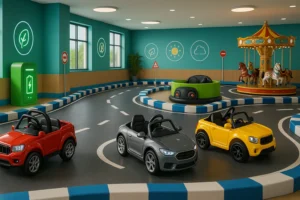
Which Application Solutions for Interactive Induction Driving School Vehicles fit your venue? 🧭🏟️
- Indoor Edutainment Zones: BLE beacons + UWB anchors create game routes with checkpoints and timed sections.
- School Yards & Camps: Magnet strips or printed QR markers define lanes, stop lines, and parking boxes.
- Shopping Mall Pop-ups: Compact tracks with wireless pads for quick charging between sessions—hottest choice during peak seasons.
- Corporate STEM Events: Telemetry-led challenges: smooth cornering, perfect stop distance, and mirror checks = points.
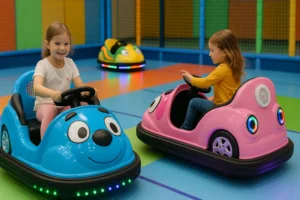
Are Induction Ride-On Vehicles Suitable for Kids’ Driving Practice? 👧🧒
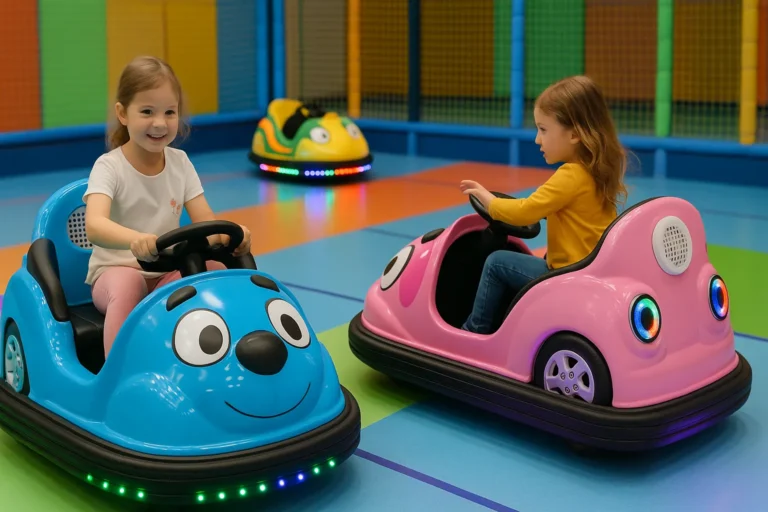
Absolutely—provided the controls, limits, and coaching feedback are purpose-built:
- Speed & Torque Maps: Age-based profiles with soft caps.
- Adaptive Coaching: Emoji-based HMI cues (😊 smooth steer, 😬 harsh brake) improve comprehension.
- Proximity Guard: Ultrasonic slow-down near obstacles, instructor override within 10–15 m.
- Gamified Curriculum: Collect badges: “Perfect Park,” “Signal Star,” “Mirror Master.” The game layer boosts repeat visits and learning retention.
What are the pros & cons of key charging and battery options? 🪫⚖️
| Option | Advantages ✅ | Drawbacks ⚠️ | Best Use Case 💡 |
|---|---|---|---|
| LiFePO₄ + Contact Dock | Safe chemistry, long cycle life, lower price, fast charge | Heavier; dock cleanliness needed | Schools with frequent cycles and budget focus |
| NMC + Inductive Pad | Higher energy density, sealed/waterproof ops, quick turnarounds | Higher cost; alignment | Premium venues; outdoor, wet or sandy environments |
| Swappable Packs | Zero-downtime fleet, simple sizing | Extra packs add cost; handling SOPs | Events with uneven peaks, small tracks |
| Solar-Assist Pit | PR-friendly, eco-friendly/environmentally friendly | Supplemental only; adds CAPEX | Outdoor camps & CSR programs |
How do we ensure safety, durability, and low maintenance? 🛡️🧰
- Structural: Rounded edges, impact-resistant bumpers, torsion-tuned frame.
- Ingress: IP-rated seams, underbody sealant for waterproof confidence.
- Thermal: Motor/BMS derating, airflow channels, active pack venting.
- UV & Finish: UV-stable gelcoat keeps the sun-resistant finish bright.
- Serviceability: Tool-less access panels, QR-coded parts, and OTA diagnostics.
- Sustainability: Recyclable cable reels, RoHS parts, and eco-friendly materials.
What does an implementation roadmap look like? 🗺️🚀
- Discovery & Custom Design (OEM/ODM): Define curriculum, throughput targets, and track footprint.
- Prototype Build: Validate Hardware BOM and coaching algorithms with a 1–3 car pilot.
- Safety & Compliance: E-stop range, child ergonomics, EMC checks, and signage standards.
- Pre-Production: Finalize vendor list (supplier/manufacturer), service SOPs, spare kits, and staff training.
- Launch: Marketing hooks (“Earn your Driver Badge!”), seasonal promos, order flow, and CRM integration.
- Operate & Improve: Use telemetry to refine scoring, charge windows, and track layout.
Pricing depends on charging style, battery chemistry, and custom design. Contact willinteractive for a tailored quote aligning latest features with your budget.
With LiFePO₄ and balanced routes, expect a long battery life operational window suitable for back-to-back sessions. Fast dock-charging or inductive pads close gaps during peaks.
Yes. Bodywork is impact-resistant, sun-resistant, and waterproof at key ingress points. Sensors and HMI are enclosed; the fiberglass structure resists weathering.